
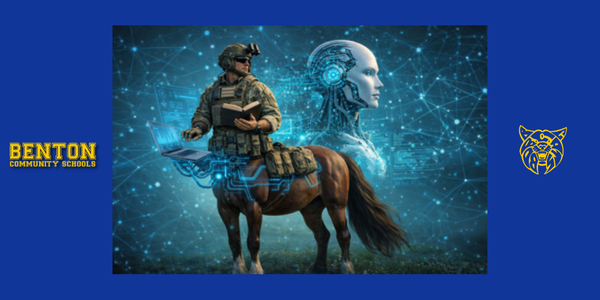
In military terms, an “offset strategy” is some strategic positioning that seeks to maintain an advantage over a long period of time, or otherwise shift strategic paradigms so that a disadvantage becomes an advantage. The first so-called offset strategy in American military history emerged under the reign of Dwight D. Eisenhower, who favored a long-term reliance on nuclear weapons as a cheaper deterrence policy. The second offset strategy occurred after the Vietnam war, where American military leaders sought to rely on their technological advantage on the battlefield. In modern times, the Americans have entered a third offset strategy phase as technological advancements have proliferated and the dawn of artificial intelligence has emerged. In this third offset strategy, the Americans are seeking to pair AI with a human. The thought process being simple: other countries may copy our technology, but they cannot match our people.
The idea of pairing human action with technology ought to apply to our students as well. No individual can be expected to memorize or know all that is available to us via the internet or AI machines. While these new technologies may be able to access facts and information faster than any human, the technology cannot operate well on its own and students who rely on these technologies to do the work for them are not reaching the full potential of AI. In order for our students to succeed in navigating the modern world they must be trained to use technology to assist their human mind, not replace it.
In American History class, the process for training students to do this can be reduced to two steps. First, our students must be taught skills of critical analysis. Technology has the ability to oversimplify complicated ideas. Students working with the technology should read the results of a search or AI prompt carefully, asking the proper probing questions and double checking sources rather than just assuming the answer is correct. Critical analysis skills will also allow students to compare competing answers and synthesize disparate pieces of information into an original idea. Second, and perhaps most important, students must be given a general background of knowledge. In order to prompt the technology, students have to know where to begin. They also need to weigh the results against their broad body of knowledge so they can quickly identify misinformation. Finally, they must be equipped with the vocabulary and information to understand the results. Otherwise, we would be blindly trusting AI to think for us.
I doubt many of you reading this would get behind the wheel of a self-driving vehicle without carefully monitoring the decisions the technology makes. How could you do this if you did not learn to drive on your own first? In the same way, AI technology is positioned to make our student’s lives much more streamlined. Yet skipping the vital steps of learning and leaning heavily on technology is not going to yield the best results. Encourage your student to learn without the technology first so that they may properly use that technology to its fullest potential. You wouldn’t let your $250,000 combine operate without a human in the cab; don’t let your child do so either. Technology can be an incredibly useful tool when paired with the human mind – like a technological centaur.